
Geopolitical uncertainty doesn’t arrive quietly; it shows up all at once, reshaping markets in real time. Global conflict, policy shifts, and economic instability can quickly create volatility that feels impossible to predict. In those moments, investors are flooded with information, opinions, and headlines competing for attention. But in my experience, the real challenge isn’t a lack of information; it’s how decisions are made under pressure.
At Encompass Wealth Management, we don’t build portfolios around predictions; we build systems designed to operate in the face of uncertainty. Because when the stakes are high, success is not about guessing what happens next; it’s about having a structure that can withstand what no one can predict. That’s why our focus isn’t on speculation; it’s on building a disciplined framework that starts with protecting capital and making decisions that hold up over time.
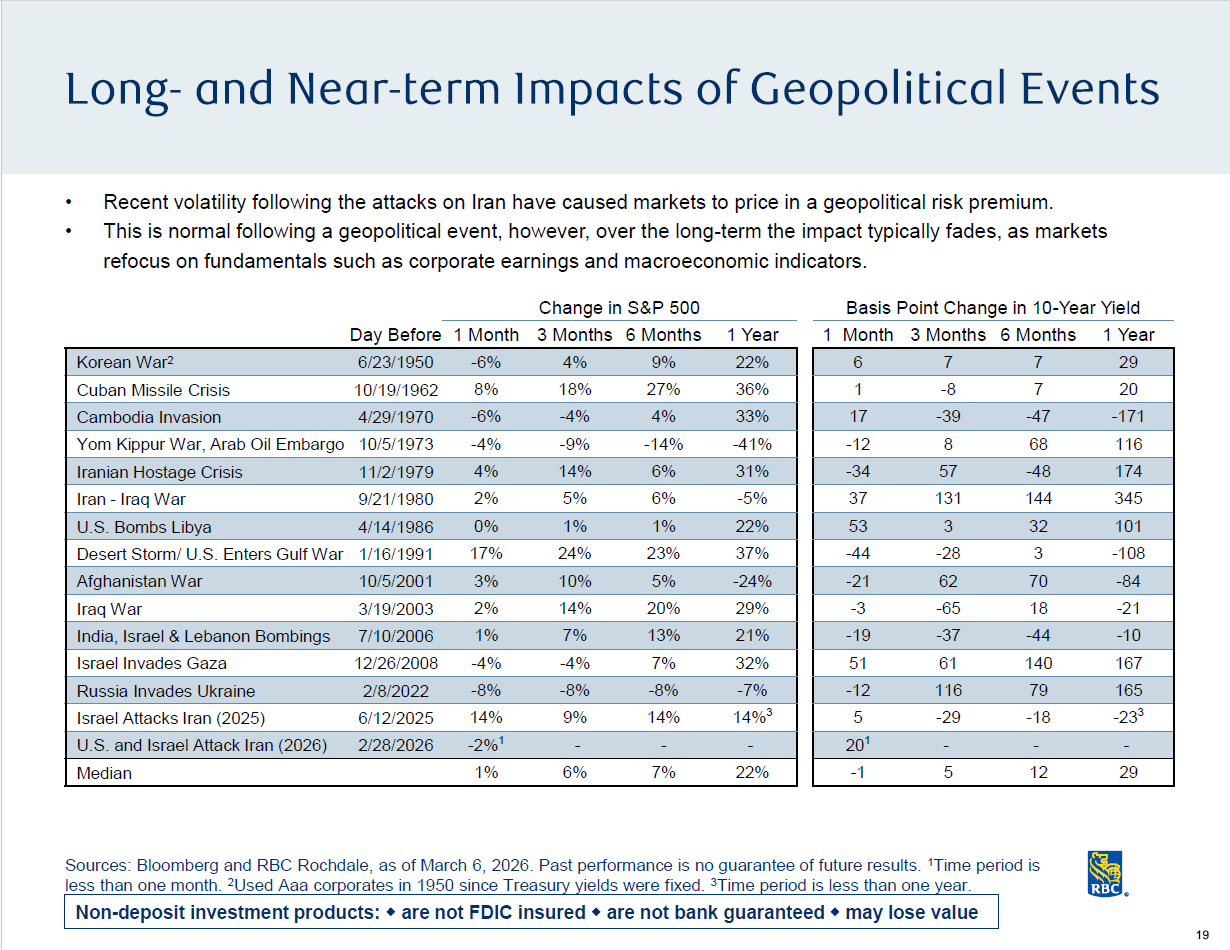
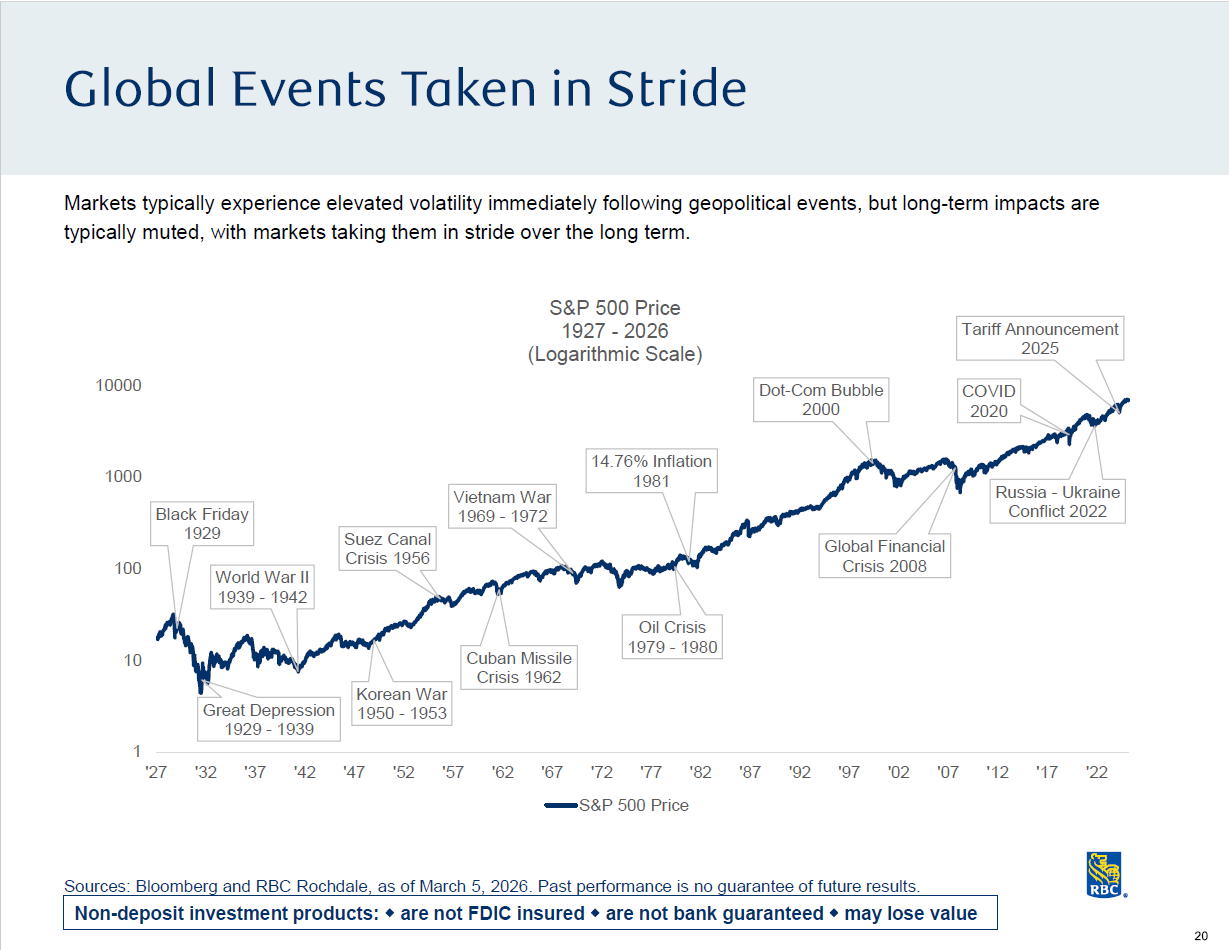
A strong wealth strategy begins with protecting what you’ve built before focusing on growth. History shows that while geopolitical events often cause short-term market disruption, their long-term impact is typically limited. According to data from the S&P 500, the index has experienced a median decline of just 1% immediately following major geopolitical events, followed by average gains of 6% after one month, 7% after three months, and 22% over one year.
Based on experience over time, the real risk is not the event itself, but how investors respond to it. Poor structure and forced decisions, often driven by concentration risk or liquidity constraints, can turn temporary market disruption into permanent loss. A properly structured portfolio is designed to absorb short-term shocks without requiring reaction, allowing investors to stay disciplined. At the same time, markets refocus on fundamentals like earnings and economic conditions.
That structure not only protects capital but also creates flexibility to act, because in uncertain markets, the ability to move strategically often matters just as much as the ability to withstand risk.
Liquidity is often misunderstood as idle capital, but in reality, it is one of the most strategic tools in a portfolio. In periods of uncertainty, liquidity provides flexibility and control, allowing investors to meet obligations, avoid selling high-quality assets at unfavorable times, and take advantage of opportunities when others are constrained.
I’ve seen this play out in real time. During the 2008 financial crisis, many investors were forced to sell assets at significant losses due to liquidity constraints, while those with available capital could acquire high-quality investments at deeply discounted valuations. More recently, following the sharp market decline in early 2020, markets rebounded rapidly, rewarding investors who were positioned to act rather than react.
Investors who plan ahead, with capital intentionally set aside for deployment, can move with clarity instead of hesitation. Liquidity transforms uncertainty from a risk into a potential advantage, enabling you to be proactive rather than reactive.
But taking advantage of opportunity only works if your foundation is secure, because before capital can be deployed effectively, it must first be protected.
In periods of global uncertainty, the biggest threat to long-term performance is often not the market itself, but investor behavior. Headlines are designed to capture attention, not guide strategy, and reacting to short-term noise can lead to costly decisions that disrupt long-term outcomes.
I often remind clients that emotional decisions, whether it’s selling during downturns or chasing momentum during rebounds, can erode value over time, even in otherwise strong portfolios. Maintaining a disciplined, consistent approach keeps you aligned with your strategy and helps you avoid unnecessary setbacks.
That discipline becomes even more effective when decisions are anchored to your personal financial structure, including your cash flow needs, time horizon, tax considerations, and long-term legacy goals, rather than the daily news cycle. At Encompass Wealth Management, we work closely with our clients to provide structure, perspective, and ongoing guidance. Hence, decisions stay grounded in strategy, not emotion. Through proactive planning and regular reviews, we help ensure that short-term uncertainty does not derail long-term progress.
Because discipline is only as strong as the structure behind it, the next step is ensuring your strategy is intentionally built to support it.
A resilient portfolio is not built in response to market events; it is designed in advance with a clear purpose and structure. This means separating core, long-term capital from opportunistic capital, so each serves a distinct role without interfering with the other. Core capital should remain invested for durability and compounding. In contrast, opportunistic capital is positioned to act with patience and flexibility when conditions shift.
Just as important, diversification should be intentional, extending across asset classes and economic environments to create stability rather than unnecessary complexity. History supports this approach, as markets have demonstrated the ability to recover and grow over time, with data showing median gains of 22% one year following geopolitical events, reinforcing the value of staying properly allocated rather than reacting to short-term disruptions.
When portfolios are built with intention, you’re better positioned to remain consistent, avoid emotional decision-making, and allow each component of your strategy to perform as designed.
When these elements come together, they form a cohesive framework, one that is not dependent on predicting the future but on being prepared for it.
Geopolitical uncertainty is not a temporary condition; it is a constant part of investing. Markets will continue to react to global events, headlines will continue to shift sentiment, and uncertainty will always be present in one form or another. In my experience, the difference between reactive and successful investors is not their ability to predict these events, but their ability to remain disciplined through them.
At Encompass Wealth Management, our focus is not on trying to outguess the market, but on building strategies that are prepared to perform across a wide range of outcomes. Because in the end, the most effective plan is not the one that gets every prediction right; it’s the one built to endure whatever comes next.
If your current strategy depends on reacting to market events or feels uncertain during periods of volatility, it may be time to take a more structured approach. I’d welcome the opportunity to take a closer look at how your portfolio is positioned and help you build a strategy designed for long-term confidence.
Connect with our team at Encompass Wealth Management to start that conversation: https://encompasswealthmgmt.com/
Citations:
Financial crisis of 2008 | History | Research Starters | EBSCO Research
https://acrobat.adobe.com/id/urn:aaid:sc:VA6C2:7999f266-fe3b-49e2-9316-fb2d288003cc